If Your Inventory Report Takes 3 Days, You Don’t Have Control. You Have Paperwork.
If your inventory report takes 3 days to prepare, your business isn’t system-driven – it’s paperwork-driven. Real-time visibility through ERP software transforms inventory chaos into scalable operational control.

In a scaling business, inventory management is not a back-office task.
It directly impacts:
- Cash flow
- Customer satisfaction
- Order fulfilment speed
- Demand forecasting accuracy
- Profit margins
Yet many growing SMEs in India still rely on:
- Excel spreadsheets
- Tally for accounting
- Manual warehouse updates
- WhatsApp confirmations
If your inventory report takes 3 days to prepare, you don’t have operational control.
You have paperwork.
The Hidden Risks of Excel-Based Inventory Management
Excel feels flexible. But flexibility without structure creates risk.
Why Excel Fails as an Inventory Management System
| Problem | What Happens | Business Impact |
| Broken formulas | Stock miscalculated | Wrong purchase decisions |
| Version conflicts | Multiple “final” files | Confusion across teams |
| Manual data entry | Human error | Inventory mismatch |
| No real-time sync | Delayed updates | Overselling / stockouts |
| No audit trail | No accountability | Fraud & compliance risks |
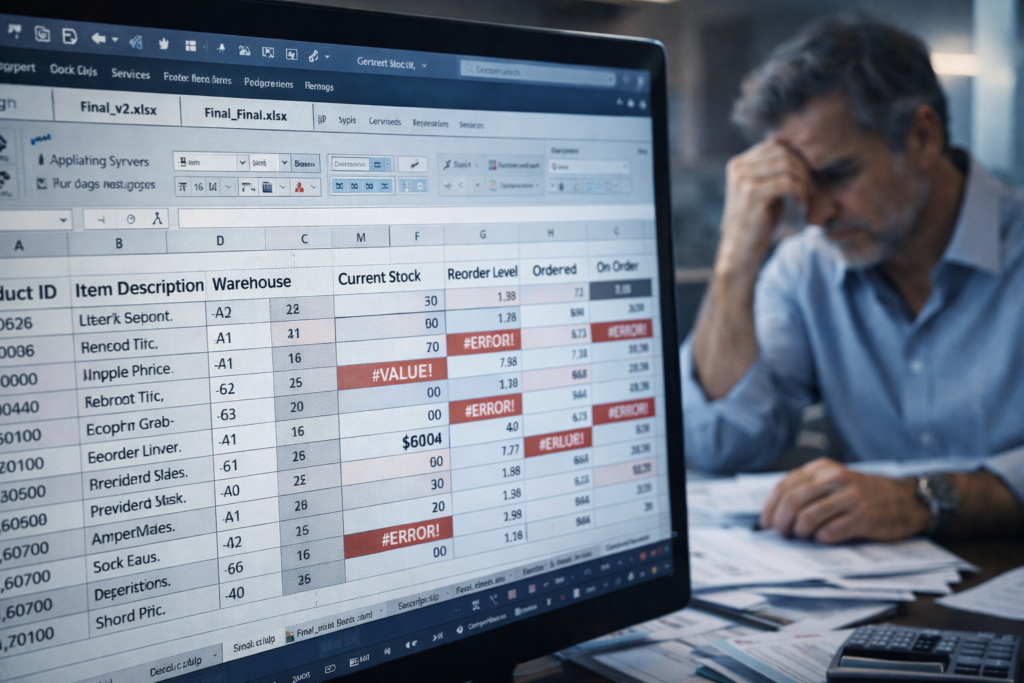
Excel is a calculation tool – not an ERP software solution.
It lacks:
- Automated stock movement tracking
- Batch & serial tracking
- Multi-warehouse visibility
- Integrated accounting
That’s not inventory control. That’s reactive reporting.
Tally Is Accounting – Not Operations
Tally is excellent for:
- Ledger management
- GST compliance
- Financial reporting
But accounting software records transactions after they happen.
It does not manage:
- Live warehouse operations
- Pick-pack-ship workflows
- Purchase planning
- Reorder automation
- Real-time stock availability
Accounting vs ERP System
| Feature | Accounting Software | ERP Software |
| Financial Reports | Yes | Yes |
| Real-Time Inventory Tracking | No | Yes |
| Warehouse Management | No | Yes |
| Automated Reordering | No | Yes |
| Multi-Department Integration | Limited | Fully Integrated |
| Demand Forecasting | Manual | Data-driven |
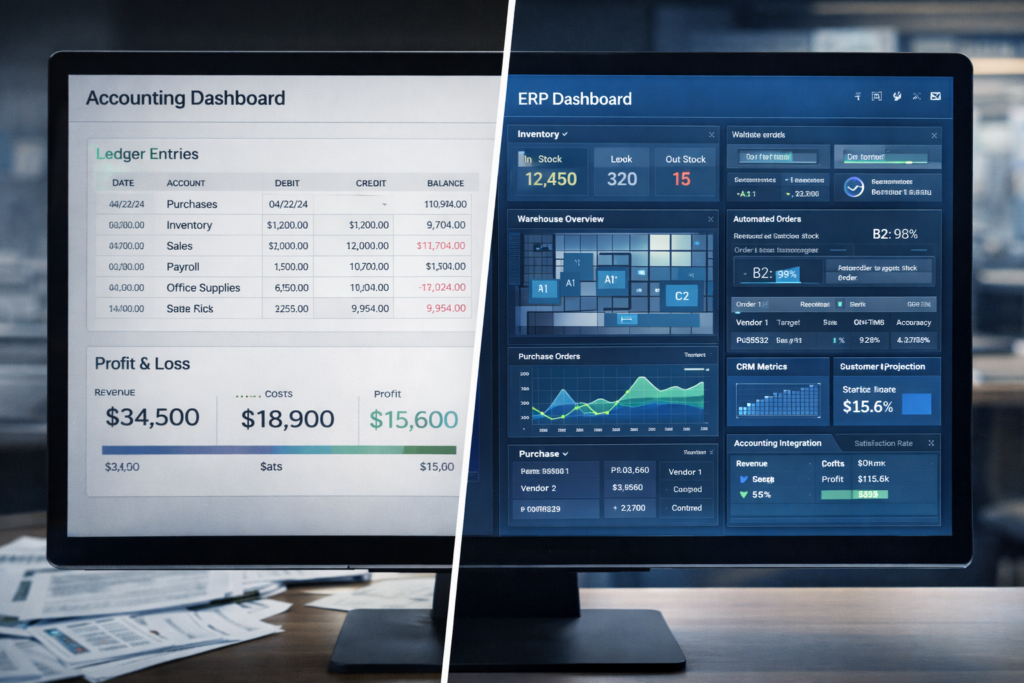
This gap creates friction between:
- Sales team
- Warehouse team
- Finance team
- Founders
And when departments don’t share real-time data, scaling becomes chaotic.
The Real Cost of Delayed Inventory Reporting
When reports take 2–3 days, the consequences are measurable.
Financial Impact Breakdown
| Operational Issue | Direct Impact | Long-Term Damage |
| Overselling | Order cancellations | Loss of customer trust |
| Dead inventory | Capital blockage | Reduced cash flow |
| Inaccurate forecasting | Excess procurement | Margin erosion |
| Manual reconciliation | High admin cost | Slow decision-making |
| Data mismatch | Internal conflicts | Leadership distraction |
Delayed data = delayed decisions.
In competitive markets, delay equals revenue loss.
What Real Inventory Control Looks Like

A modern Inventory Management System (IMS) inside an ERP provides:
- Real-time stock visibility
- Automatic updates after every transaction
- Integrated purchase, sales, and accounting
- Centralized dashboards
- Multi-location warehouse tracking
You should instantly know:
- Available stock
- Reserved stock
- In-transit stock
- Dead inventory
- Fast-moving SKUs
- Gross margin per product
If these require manual consolidation, your system is outdated.
How Odoo Solves Inventory Chaos
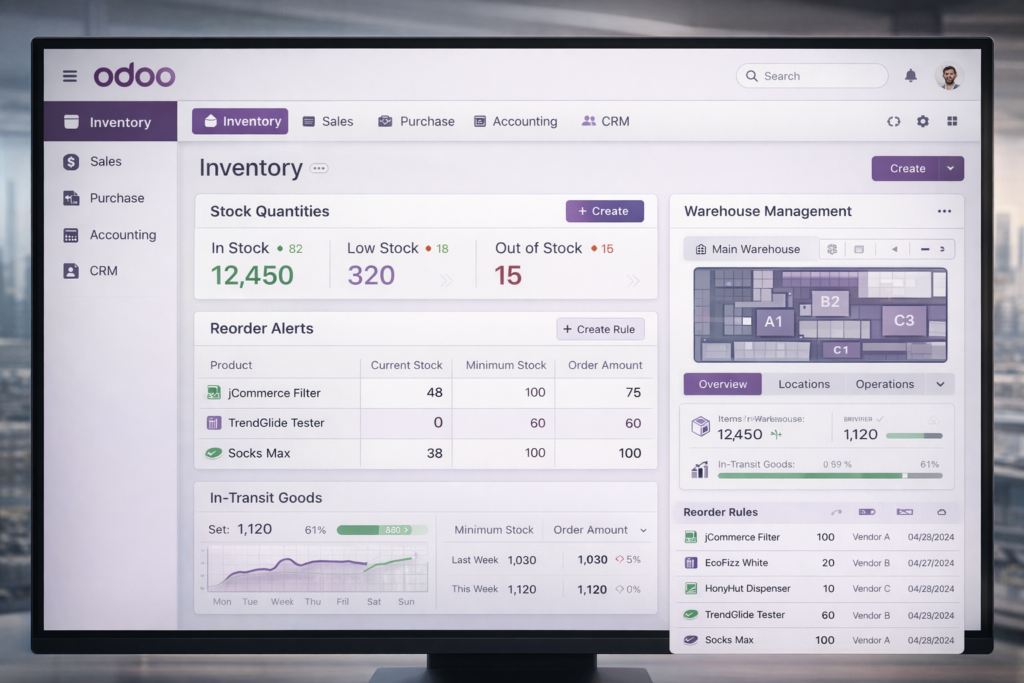
Odoo is a fully integrated ERP platform designed for SMEs and mid-sized businesses.
It combines:
- Inventory
- Accounting
- Sales
- Purchase
- CRM
- Manufacturing
- Reporting & Analytics
All in one system.
Key Inventory Features in Odoo ERP
| Feature | Benefit |
| Real-Time Inventory Tracking | Instant stock updates |
| Multi-Warehouse Management | Location-wise visibility |
| Batch & Serial Tracking | Traceability & compliance |
| Automated Reordering Rules | Prevent stockouts |
| Integrated Accounting | Auto inventory valuation |
| Barcode Integration | Faster warehouse operations |
| Smart Reporting Dashboards | Data-driven decisions |
Instead of asking employees for numbers, founders see dashboards instantly.
ERP Implementation: When Should You Upgrade?
You likely need an ERP system if:
- Inventory reporting takes more than 24 hours
- You manage 100+ SKUs
- You sell across multiple channels (offline + online)
- You operate multiple warehouses
- Your teams constantly reconcile mismatched data
- Founder involvement in daily stock queries is high
ERP Readiness Checklist
| Question | Yes/No |
| Do you face frequent stock mismatches? | |
| Is reporting manual and time-consuming? | |
| Are departments using separate software? | |
| Is demand forecasting unreliable? | |
| Is growth increasing operational confusion? |
If you answered “Yes” to 3 or more – ERP implementation should be a priority.
ERP Is Revenue Infrastructure – Not Just Software
Most businesses treat ERP as an expense.
But ERP is infrastructure for:
- Predictable growth
- Financial accuracy
- Inventory control
- Business automation
- Scalable operations
Without ERP:
- Growth creates complexity
- Complexity creates errors
- Errors reduce profitability
With ERP:
- Systems replace chaos
- Data replaces assumptions
- Visibility replaces dependence
Final Thought
If your inventory report takes 3 days:
You don’t have operational control.
You have paperwork.
And paperwork doesn’t scale.
Digital transformation is no longer optional for growing Indian SMEs.
The real question is not:
“Do we need ERP software?”
It’s:
“How much longer can we afford to operate without real-time inventory control?”
FAQs
Question: Why is Excel not suitable for inventory management at scale?
Answer: Excel lacks real-time updates, automation, and integration across departments. As SKU count and transactions increase, manual spreadsheets lead to errors, stock mismatches, and delayed decision-making.
Question: What is the difference between accounting software and ERP software?
Answer: Accounting software records financial transactions, while ERP software integrates inventory, sales, purchase, warehouse, and accounting into one unified system for real-time operational control.
Question: When should a business implement an ERP system?
Answer: You should consider ERP implementation when inventory reports take too long, stock mismatches are frequent, departments use disconnected tools, or growth creates operational confusion.
Question: How does Odoo help with inventory control?
Answer: Odoo provides real-time inventory tracking, automated reordering, multi-warehouse management, and integrated accounting – ensuring one source of truth across the organisation.