Why Growing Businesses Fail with Excel and Succeed with ERP
Excel works early-but breaks as you scale. This blog explains why growing businesses outgrow spreadsheets and how ERP systems like Odoo restore control, accuracy, and growth.

For many startups and growing businesses, Excel feels like a lifesaver.
It’s familiar. It’s cheap. It’s flexible.
But here’s the uncomfortable truth
Excel is one of the biggest silent reasons why growing businesses stall, struggle, or fail.
What works for a 5-member team breaks badly at 20, 50, or 100 employees.
In this blog, we’ll break down:
- Why Excel collapses as businesses scale
- The hidden operational risks nobody talks about
- How ERP systems (like Odoo ERP) help companies regain control
- When exactly should you move from Excel to ERP
If you’re a founder, ops head, or decision-maker, this will hit close to home.
The Comfort Trap: Why Businesses Stick with Excel Too Long

Excel is not the problem.
Overusing Excel is.
Most businesses continue with spreadsheets because:
- “It’s working fine for now”
- “ERP feels expensive and complex”
- “We’ll move later, once we grow more”
Unfortunately, by the time “later” comes, the damage is already done.
The Real Problems with Excel (That Kill Growing Businesses)
Let’s talk about the actual pain points, not surface-level issues.
1. Manual Processes Eat Your Team Alive

Every growing business reaches a stage where Excel workflows look like this:
- Data copied from one sheet to another
- Multiple versions shared on email or WhatsApp
- Endless follow-ups for updates
- “Who changed this cell?” panic moments
Result:
- Wasted man-hours
- Burnt-out teams
- Slower execution
Manual work doesn’t just slow growth – it actively blocks it.
2. Zero Single Source of Truth
Ask these questions inside an Excel-driven company:
- What’s today’s real inventory?
- Which invoices are pending?
- What’s the actual profit this month?
You’ll get five different answers.
Why?
Because Excel data is:
- Scattered across files
- Updated inconsistently
- Owned by individuals, not systems
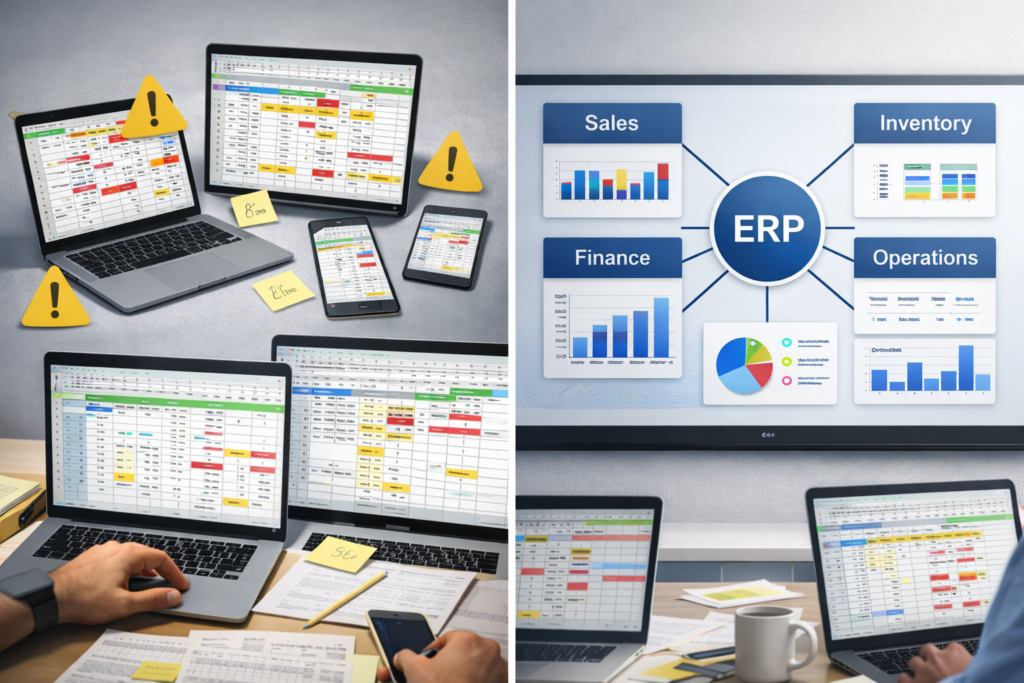
Excel vs ERP: Data Reality Check
| Aspect | Excel-Based System | ERP System |
|---|---|---|
| Data Storage | Multiple files | Centralized database |
| Real-time Updates | No | Yes |
| Version Control | Manual | Automatic |
| Cross-team Access | Limited | Role-based |
| Decision Confidence | Low | High |
3. Reporting Is Always Late (and Often Wrong)

By the time reports are ready:
- The opportunity is gone
- The damage is already done
With Excel:
- Reports depend on manual inputs
- Errors go unnoticed
- Management decisions are based on outdated numbers
Growing businesses don’t fail because they lack data.
They fail because they can’t trust their data.
4. Errors Scale Faster Than Revenue
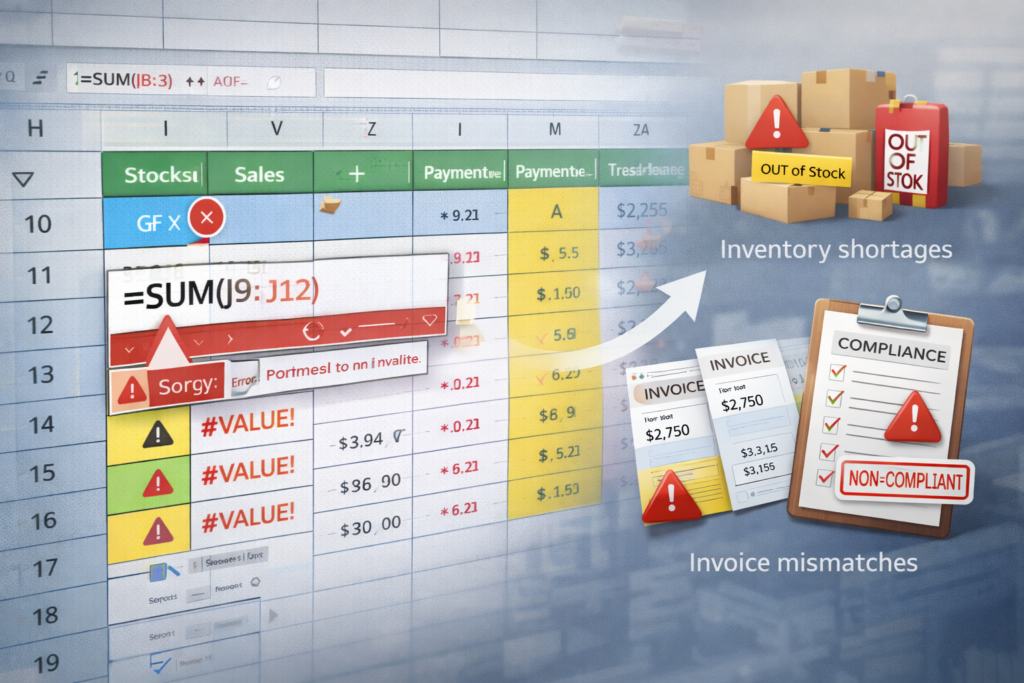
A small Excel error at an early stage is manageable.
But as volume grows:
- One wrong formula impacts hundreds of transactions
- Inventory mismatches lead to stockouts or overstock
- Incorrect GST or tax data creates compliance risks
ERP systems reduce human error by design.
5. Excel Can’t Grow With You
Excel doesn’t scale with:
- Multiple locations
- Multiple warehouses
- Large sales teams
- Integrated finance, CRM, and inventory
At scale, Excel becomes a patchwork of hacks, not a system.
Why ERP Is Built for Growing Businesses
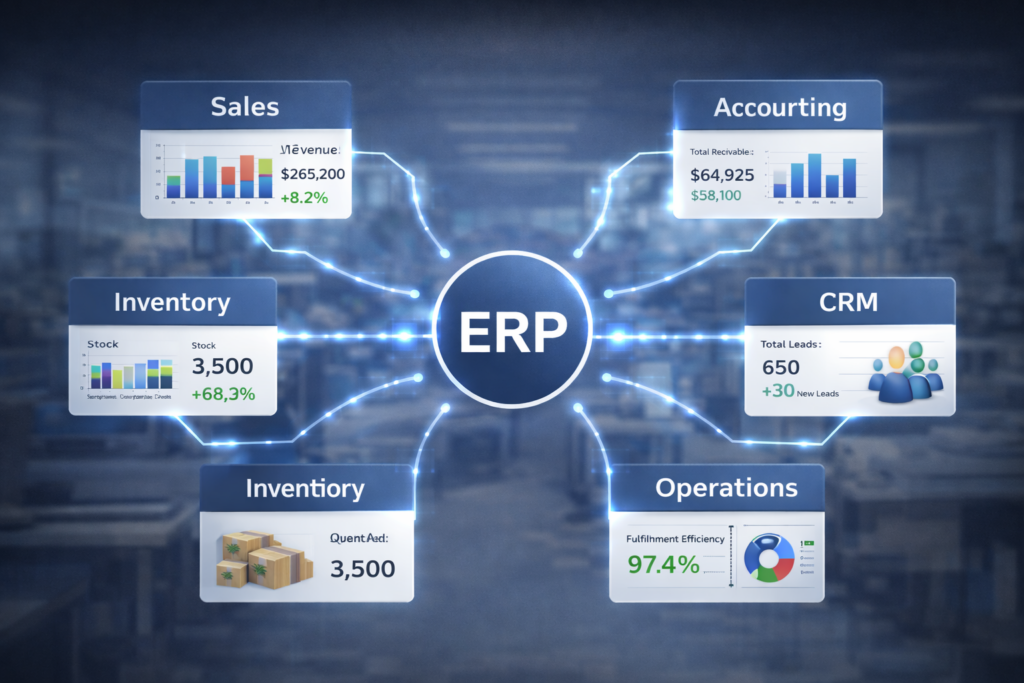
ERP (Enterprise Resource Planning) systems are designed to do one thing extremely well:
Run your business as one connected system.
Instead of disconnected spreadsheets, ERP connects:
- Sales
- Inventory
- Accounting
- CRM
- Operations
- Reporting
All in real time.
How ERP Solves Excel’s Biggest Failures
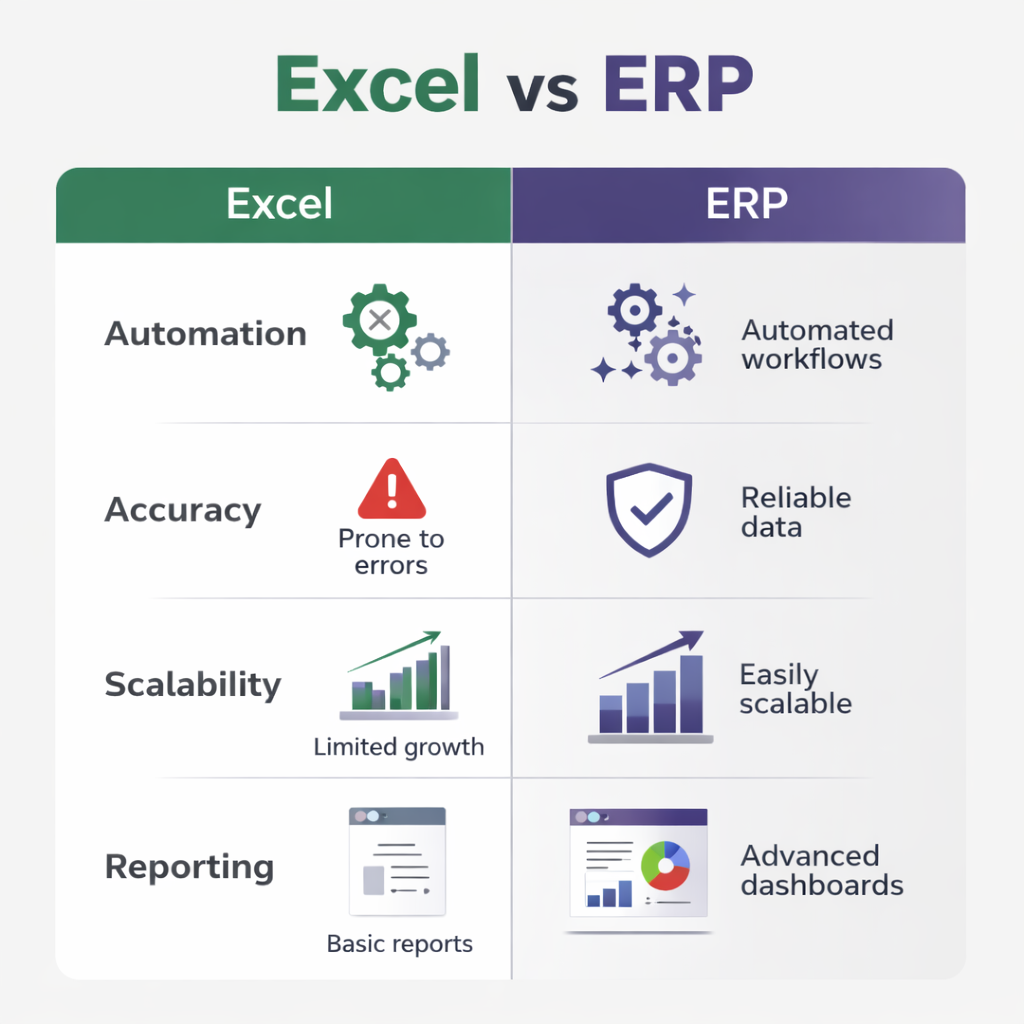
ERP vs Excel: Business Impact Comparison
| Business Area | Excel | ERP |
|---|---|---|
| Automation | Manual | Automated workflows |
| Reporting | Delayed | Real-time dashboards |
| Accuracy | Error-prone | System-validated |
| Scalability | Poor | Built for growth |
| Compliance | Risky | Structured & auditable |
| Decision Making | Reactive | Proactive |
Real Example: Excel vs ERP in Daily Operations
With Excel:
- Sales updates stock manually
- Finance updates invoices separately
- Ops reconciles data weekly
With ERP (like Odoo ERP):
- Sale is confirmed → stock updates automatically
- The invoice is generated instantly
- Management dashboard updates in real time
That’s the difference between surviving and scaling.
Why Odoo ERP Is a Popular Choice for Growing Businesses

Many businesses hesitate to adopt ERP because they think it’s:
- Too expensive
- Too rigid
- Only for large enterprises
That’s where Odoo ERP stands out.
Why Businesses Choose Odoo ERP
- Modular (start small, scale gradually)
- Cost-effective compared to traditional ERPs
- Covers CRM, Inventory, Accounting, Manufacturing, HR, and more
- Highly customizable for Indian businesses
- Strong ERP automation capabilities
It bridges the gap between Excel chaos and enterprise-level control.
Signs You’ve Outgrown Excel (Be Honest)
If you say “yes” to 2 or more, it’s time to consider ERP:
- Reports take days instead of minutes
- Teams argue over whose data is correct
- Inventory numbers never match reality
- Manual work is increasing, not reducing
- Growth feels stressful instead of exciting
The Hidden Cost of Staying on Excel
Businesses often ask:
“What’s the cost of implementing ERP?”
The better question is:
What’s the cost of NOT implementing ERP?
Hidden Excel costs include:
- Lost revenue due to slow decisions
- Operational inefficiencies
- Employee burnout
- Customer dissatisfaction
- Compliance risks
ERP is not an expense.
It’s a growth enabler.
Final Thoughts: Excel Is a Tool, ERP Is a System
Excel is great for:
- Small teams
- Simple tracking
- Short-term needs
But growing businesses need:
- Automation
- Accuracy
- Visibility
- Scalability
That’s exactly where ERP systems like Odoo ERP succeed.
If your business is growing and Excel is starting to feel like a bottleneck – that’s not a coincidence.
Ready to Move Beyond Excel?
If you’re unsure whether ERP is right for your business, the best next step is clarity, not commitment.

Book a free ERP audit
Understand:
- Where Excel is hurting you
- What processes can be automated
- Whether Odoo ERP fits your growth stage
Growth should feel exciting – not chaotic.
FAQs
Question: Why is Excel not suitable for growing businesses?
Answer: Excel lacks automation, real-time data updates, and centralised control. As businesses grow, manual processes, data errors, and delayed reporting increase, making Excel inefficient for scalable operations.
Question: When should a business move from Excel to ERP?
Answer: A business should consider ERP when reporting becomes slow, data accuracy drops, teams rely heavily on manual work, or operations span multiple departments, locations, or warehouses.
Question: How does ERP solve problems caused by Excel?
Answer: ERP systems automate workflows, centralise data, reduce human errors, and provide real-time visibility across sales, inventory, accounting, and operations-something Excel cannot do efficiently.
Question: Is ERP only for large enterprises?
Answer: No. Modern ERP systems like Odoo are modular and cost-effective, making them ideal for startups and growing businesses that want to scale without operational chaos.
Question: Why is Odoo ERP good for businesses using Excel?
Answer: Odoo ERP offers flexible modules, ERP automation, real-time reporting, and customisation at a lower cost compared to traditional ERP systems, making it a strong upgrade from Excel.