Why Indian Factories Lose 10-20% Productivity Due to Poor Material Planning
Poor material planning silently drains 10–20% productivity from Indian factories through stockouts, excess inventory, and manual Excel-based planning. By improving inventory visibility and production planning systems, manufacturers can recover lost capacity without new capital investment.
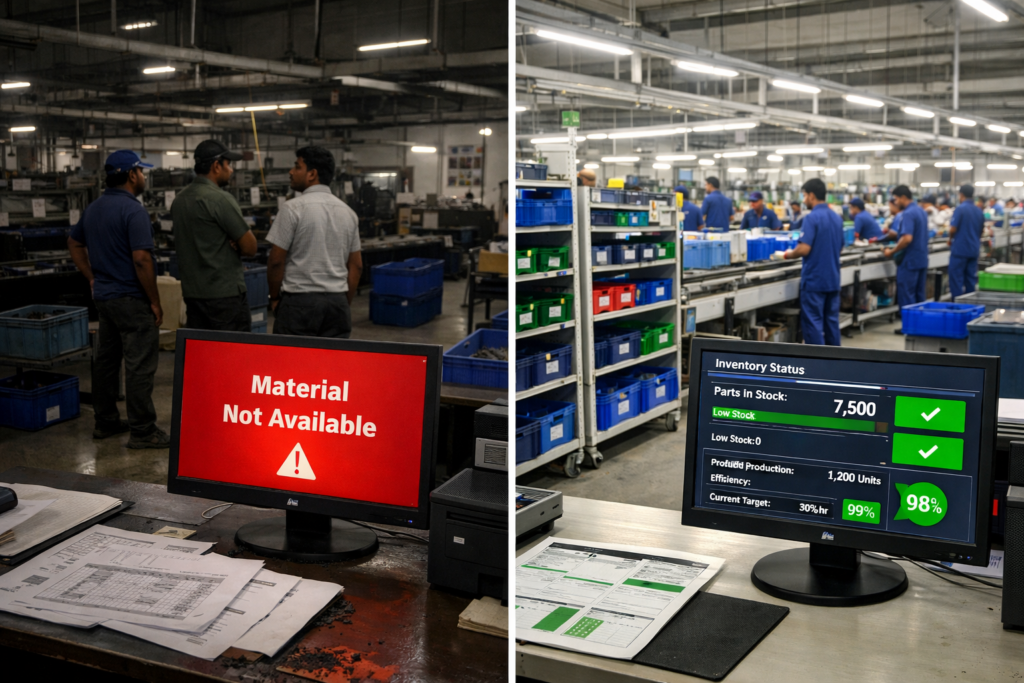
In many Indian manufacturing plants, productivity loss doesn’t happen because of machine breakdowns or lack of manpower.
It happens because of poor material planning.
Missing raw materials.
Excess stock is blocking space.
Wrong components were issued to the shop floor.
Urgent purchases.
Unplanned line stoppages.
Individually, these look like minor operational issues.
Collectively, they silently drain 10-20% of factory productivity every year.
If you are a Plant Manager, Operations Head, or CFO, this article will show you where that productivity disappears – and how to recover it.
The Hidden Cost of Poor Material Planning
Material planning in manufacturing ensures:
- The right material
- In the right quantity
- At the right time
- On the right production line
When even one link fails, production efficiency drops.
Here’s how the damage shows up:
| Issue | Shop Floor Impact | Productivity Loss |
| Stockouts | Line stops, workers idle | 2–8% daily loss |
| Excess Inventory | Space clutter, longer search time | 3–5% drop |
| Wrong BOM | Rework, scrap | 2–6% loss |
| Manual Excel Planning | Forecast mistakes | 3–7% inefficiency |
| Poor Supplier Coordination | Expediting & chaos | Increased downtime |
Even small, repeated disruptions compound into double-digit productivity losses.
Why This Is So Common in Indian Factories
Many Indian MSME manufacturers still operate with:
- Excel-based production planning
- Tally for accounting
- Manual GRN and stock registers
- No real-time inventory visibility
- Reactive purchasing
The result?
Production decisions are based on outdated or incomplete data.
Planners either:
- Over-order (blocking working capital), or
- Under-order (causing stockouts).
Both hurt efficiency.
The Real Culprit: Micro-Stoppages
Large breakdowns are visible.
Material shortages are not.
Example:
A ₹10 fastener is missing.
The assembly line halts for 40 minutes.
25 operators stand idle.
Multiply this by 3-4 times per week across multiple lines.
That’s how factories lose 10–20% output without realising it.
The Financial Impact (For CFOs)
Assume:
- Annual turnover: ₹50 crore
- Operating margin: 12%
- Productivity loss due to planning gaps: 15%
That means ₹7.5 crore worth of productive capacity is underutilised.
Recovering even half can significantly boost profitability – without investing in new machines.
Warning Signs You Have a Material Planning Problem
You likely have inefficiencies if:
- “Material not available” is common in production meetings
- Inventory levels are high, but shortages still occur
- The purchase team does urgent buying weekly
- WIP inventory keeps rising
- Production schedules change daily
If 3+ apply, productivity is leaking.
KPIs You Must Track
| KPI | Target Benchmark |
| Material Availability | 98%+ |
| Inventory Accuracy | 95–99% |
| Stockout Rate | < 2% |
| Downtime Due to Material | < 3% |
| Inventory Turnover | Increasing trend |
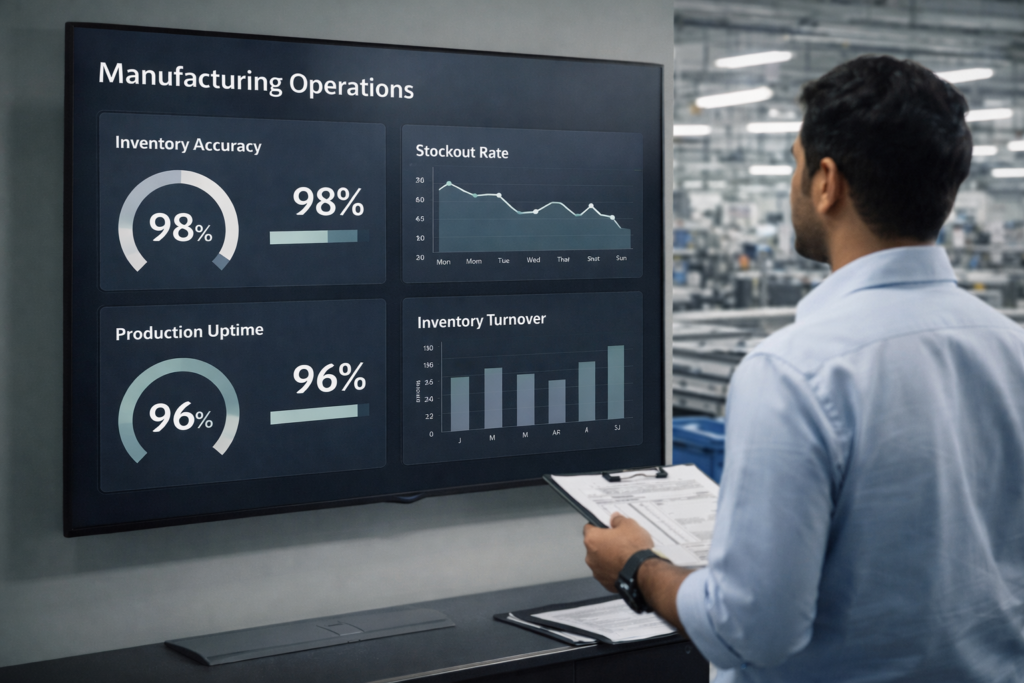
If downtime due to material issues exceeds 5%, your factory is losing serious output.
Root Causes Behind Poor Material Planning
- No integrated ERP system
- Inaccurate or outdated BOM
- No demand forecasting
- Untracked supplier lead times
- No ABC inventory classification
- No scientific safety stock method
- Disconnected sales, purchase, and production teams
Most companies respond by hiring more planners.
The real solution is better systems and structured processes.
How Smart Manufacturers Recover 10–20% Productivity
Factories that fix this problem implement:
1. Integrated Production Planning
Centralised ERP replaces scattered Excel sheets.
2. Demand-Based Replenishment
Forecasting based on historical sales and trends.
3. ABC Inventory Classification
Critical and high-value items get tighter control.
4. Scientific Safety Stock
Data-driven buffers instead of emotional overstocking.
5. Supplier Performance Tracking
Lead times become predictable.
6. Pre-Production Kitting
Material staged before the shift starts drastically reduces setup time.
Case Snapshot
A mid-sized engineering manufacturer faced:
- 8–10 stockouts per week
- High overtime
- Rising inventory levels
After implementing structured material planning:
- Stockouts reduced by 70%
- Inventory reduced by 18%
- Throughput increased by 12%
- On-time delivery improved
No new machinery was purchased.
Only planning improved.
How Odoo Helps Fix Poor Material Planning
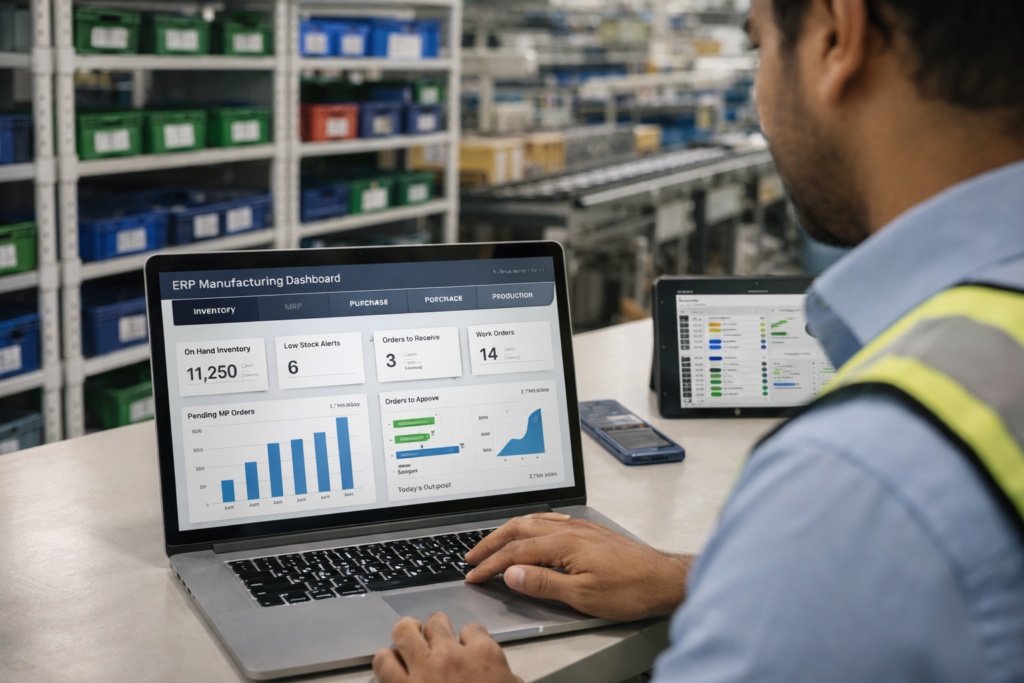
Modern ERP systems, such as Odoo Manufacturing ERP, are designedto eliminate these inefficiencies.
With Odoo, factories get:
- Real-time inventory visibility
- Automated MRP planning
- Accurate BOM management
- Procurement automation
- Supplier lead-time tracking
- Production scheduling dashboards
- Integrated purchase, inventory, and manufacturing modules
Instead of Excel-based guesswork, planning becomes data-driven.
Odoo’s Manufacturing (MRP) module connects:
Sales → Forecast → Procurement → Production → Inventory → Accounting
This integration ensures:
- No duplicate data
- Fewer manual errors
- Faster decision-making
- Reduced stockouts
- Lower excess inventory
Many Indian manufacturers shifting from Tally + Excel to Odoo report noticeable improvements in:
- Production uptime
- Inventory accuracy
- Working capital efficiency
- On-time delivery
The biggest benefit?
You recover productivity without increasing manpower.
Conclusion
Poor material planning is not just an inventory issue.
It is a strategic productivity challenge.
If your plant constantly reschedules production, faces stockouts, or depends on urgent purchases, you are not short on machines.
You are short on planning clarity.
Fix your material planning process, implement the right systems, and you could unlock 10–20% additional productivity without adding a single new machine.
In today’s competitive manufacturing environment, that advantage matters.
FAQs
Que. How does poor material planning reduce factory productivity?
Ans. Poor material planning causes stockouts, excess inventory, and production delays. When materials are unavailable at the right time, assembly lines stop, workers remain idle, and overall manufacturing efficiency drops.
Que. What are the signs of poor material planning in manufacturing?
Ans. Common signs include frequent stockouts, high inventory but material shortages, urgent purchasing, rising WIP inventory, and daily production rescheduling.
Que. How much productivity can factories lose due to stockouts?
Ans. Repeated material shortages and micro-stoppages can reduce productivity by 10-20% annually, especially in factories relying on manual planning systems.
Que. How can ERP systems like Odoo improve material planning?
Ans. ERP systems provide real-time inventory tracking, automated MRP, accurate BOM management, and integrated procurement – helping reduce stockouts, excess inventory, and production downtime.